Towards a circular, sustainable, and transformative BioWEconomy:
A Call for Action
About this initiative
Several people collaborating in various projects wondered for many years about missing links between (bio)economy, culture & arts, sustainability, and transdisciplinary science (i.e. making non-scientific actors part of the research process).
Through coffee talks and email exchanges, and nurtured by hints from friends and colleagues, this wondering cumulated during joint work into the idea of writing a Manifesto/Call for Action on a new concept : A circular, sustainable, and transformative BioWEconomy.
The writing was a collaborative inclusive process of a core group jointly delivering a short text. It has links to real-world examples worth scaling-up, and will be distributed broadly, using various (social) networks, events and other channels.
This website is to inform you about the main messages – it is not finished, though. We envision feedback through social media, jointly considering and deciding on any follow-up work.
On behalf of the initiating group Uwe R. Fritsche
Main messages
The time is now
- All over the world, manifold actors initiate change through various approaches – but few co-create, collaborate, and connect; they compete for scarce resources (audience, enthusiasm, finance, media coverage etc.).
- Parallel discussions and disputes on change flourish in cultural, economic, political, and scientific „bubbles“ and on multiple levels, implying fragmentation – while we need bridging the gaps, co-creation, productive exchange, and holistic views.
- Activists, businesses, civil society, and politicians acknowledge that business-as-usual is not an option.
At crossroads
- The e-world paradigm – i.e. electrifying everything – is getting attention: It promises “smart” cities and homes, hydrogen from renewable electricity would replace fossil and biogenic resources, e.g., “electro-meat” would get rid of animals, and free large track of land previously needed for animal feed . Such a future may contribute to sustainable development, assuming massive technology improvement…but acceptance and cost remain issues.
- In contrast, the bioeconomy could be a versatile integrator, with a different narrative – but for this, transformation is needed of the “classic” bioeconomy as a techno-economic construct to continue business as usual by substituting fossil resource with biomass:
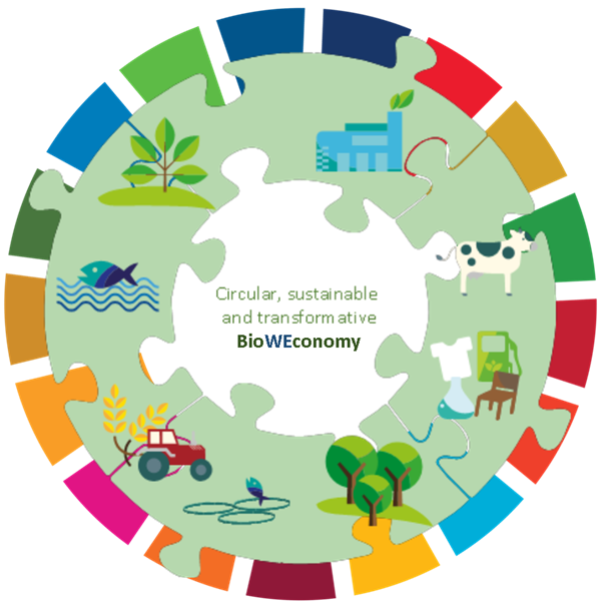
Towards a circular, sustainable, and transformative BioWEconomy which includes, stimulates, and supports transforming agriculture, fishery, forestry and waste management. The BioWEconomy could drive system changes (transformations) in society and economy, as its agents are producers, consumers, and prosumers, citizens, people – all of us.
Pathfinding, and exploration
- The BioWEconomy reaches out to new sociocultural actors (collaborative/sharing economy, commoning), and explores innovation not only in technologies but also in business modes, and social and cultural practices.
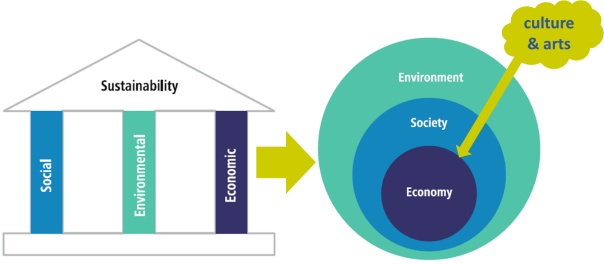
- Culture & arts are elements of a BioWEconomy, both in terms of societal and economic service provision, but require seeking and strengthening their transformative power.
- The BioWEconomy favors, as normative priorities, nature-based solutions & fair international trade, and will explore respective action.
Going together
Governing the BioWEconomy requires collaborative, multilevel approaches and new indicators, and creating trust in the BioWEconomy needs transparent and sustainable supply chains, and participatory verification (e.g. through citizen science).
Providing guidance
- Financing institutions need sustainability checks for bioeconomy investments, for which sustainability certification is not enough. Sustainability must be conditional for finance (EU Taxonomy, Green Deal, recovery packages etc.), and crowd sourcing will allow the WE approach to inclusively sponsor bottom-up projects.
- A BioWEconomy needs targets for 2030 and 2050 to guide the transformation. WE will engage in co-creating the targets and respective pathways, considering global views. Targets and pathways will focus on resource efficiency, reducing consumption levels where needed, benefitting from socio-economic and cultural transformation.
Towards integration
- The BioWEconomy could flourish through those expecting to win (a broader sense): altruistically, culturally, economically, personally, socially, status-wise…and those who expect their innovation (again in a broader sense) to be taken up in the BioWEconomy.
- On the other hand, the BioWEconomy will have opponents – those who will not benefit, including proponents of the “classic” bioeconomy (and their economic interest). This needs consideration.
- To take those on board, a hybrid strategy could help, i.e. focusing on the (near-term) transition period, less on the longer-term transformation. Examples may be the gas grid, oil refineries, etc. Yet, lock-in must be avoided.
Why BioWEconomy?
In 2018, the book WEconomy was published in the US . In the same year, two Germans published a manifesto entitled Economy to Weconomy , expanding the US approach to a more societal and economic view.
Much in parallel, Tim Jackson opened the Centre for the Understanding of Sustainable Prosperity (CUSP) , the Donuts Economic Lab started operating , Maja Göpel published The Great Mindshift , and the Wellbeing Economy Alliance was formed .
Inspired by these developments, the insertion of the “WE” into the bioeconomy to form the term BioWEconomy is already a – small – transformation.
Why the „WE“ – what’s new?
It is basically us (i.e. „WE“ in capitals as eyecatcher) driving the BioWEconomy, not abstract market forces. WE are the economy – and WE can transform it.
WE breath, drink, eat, wear clothes, get warmed, build shelter, use education, health care infrastructures etc. to cover basic needs. And beyond that, we consume. For all that we use nature . WE are part of nature, and nature is part of us. WE define our safe operating space. But our territories and policies are fragmented, there is no committee, no collaborative, no crew nor captain steering Spaceship Earth – it is on us.
WE are part of but also beyond nature: WE create, dream, innovate, reflect, think…beyond flesh and bones, we are the noosphere – and the noosphere is basically unlimited.
BioWEconomy: The role of culture and arts
Modern views of sustainability see culture and arts as “in between” society and economy, and the BioWEconomy sees socioeconomic practices as components of value generation – less in terms of GDP, more in societal value.
Cultural practices are as old as humanity – and arts are a specific expression of such practices. With changes in societies over millennia, increasing (economic) wealth and rising neoliberal concepts of how we live and interact, the market became a determining factor of cultural practices, and arts.
This concerns not only mass and new “social” media, but how museums work, how cultural practices are valued, and how products of art are marketed.
On the other hand, culture and art never before were as free, diverse, and accessible. Cultural diversity has market value, and cultural expressions such as fashion, food, music, sports, and stories (e.g. Manga comics, SF movies) increasingly escape earlier restrictions in terms of control by clans, monarchs, nations, oligarchs and potentates, religions etc. to become available for globalized customers seeking newness.
Since beginning, culture and arts are continuously transformed. With the Summer of ’69 “flower power revolution”, post-colonial opening of many countries, and better media access, cultural practices – including art – are changing faster.
The trend of 3D printing (no more “originals”) and re-emerging manufacture and crafts as counter-trends, increased digitiza¬tion and virtualiza¬tion as part of the COVID-19-driven lock-down and the experience of cultural absence or meagre ersatz of the real thing (concerts, sport events etc.) all will have influence on how cultural practices and art will develop further.
Meanwhile, artists such as Olafur Eliasson questions the relation of mankind and nature , Emma Hislop explores links of micro¬biomes in our bellies and circular economy concepts , Kristiane Kegelmann combines food art and entre¬preneur¬ship , Banksy inserts art into everyday life through subversive graffiti , Donna Haraway coined the term Chthulucene and Bruno Latour calls for Landing on Earth – these few examples indicate a fertile ground to link up with an inclusive BioWEconomy which could benefit from exposure to non-technical and post-modern views and practices.
This is needed, as humanizing the term bioeconomy is not done by adding the “WE“. It could be a good start to reach out to artists and re-define nature-based cultural practices (e.g. cooking, education, gardening, health care, walks etc.) as components of the BioWEconomy which create societal value for all.
The inclusion of traditional knowledge embedded in e.g. in agricultural practices of seed selection (as in Iran), adaptive climate architecture (as in Northern Africa), nature-based long-wearing fabrics and materials (as in e.g. Latin America and Asia) might enrich the BioWEconomy further– it’s worth a try.
Landings: Building the BioWEconomy from the ground
This section is yet under development.
BioCities and BioRegions
BioPractices
Yes, WE can – BioWEconomy for all:
Do it yourself , engage, invest…and consider the cultural practices mentioned before.